Our first winter rains have blown through and and brought a welcome refreshment after the long and hot months. As our summer bloomers are going into their winter rest, much of our traditional drought resistant landscaping is beginning to look a bit drab (unless you have one of those ever-bloomers such as Bougainvillea). The approaching holidays are creating an atmosphere of hope and expectation, and when we add to this the notion that this is an ideal time for planting in the low water landscape, we find ourselves searching the garden centers for the colorful plants that can cheer up our winter gardens. However, you’ll notice that most nurseries reserve the bulk of their space for the big sellers: Poinsettias, green wreaths, Camellias and Azaleas of course, and many winter blooming annuals. If you are more interested in exceptional xeriscape plants that don’t have to be replaced at every change of the season, that will flower through the winter months and that will add color to your garden for many years to come, read on. From the many that come to mind I have chosen a few that are un-demanding in maintenance, low in watering needs, and just outstanding plants. This list is just a first selection, and I’ll be happy to share many more with you if you contact me.
THE SHORT STUFF: xeriscape plants at around a foot height
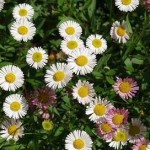 Santa Barbara Daisy Erigeron karvinskianus, is a free-blooming perennial with dainty, white/pink daisy-like flowers to ¼ inch wide and narrow leaves to 1 inch long, that gracefully trails and slowly spreads to about 3 ft with a height of 10 to 20 inches. It’s not really a winter bloomer as it has already been in bloom all summer long, but the flowers never stop coming. It likes full sun but can tolerate partial shade and is very drought tolerant. It can be a bit invasive but is not overwhelming. Use it for edgings, as groundcover, in containers and in rock gardens, in naturalized beds, hanging baskets or in dry laid walls, especially to offset plants with a coarser texture, such as fleshy Ghost Plant (see it described in “‘The “work horses” in my drought resistant landscaping”).
 Sundrops and Trailing Buttercups Calylophus drummondii & Calylophus hartwegii
These closely related perennials grow to about 1 ft high by 2 ft wide. Although not true winter bloomers, they will, if planted in a sheltered spot, continue their bloom from summer to winter, although a little more sparsely. I love them because they are long flowering must-haves for the xeriscape, undemanding in maintenance. Sheer them down to a few inches in mid spring to give them a rest and tidy them up for the next flowering season. Their brightly yellow flowers will cheer up many drab spots in your garden, in full sun or light shade, and their fine textured foliage is an excellent companion to coarser textured succulents.
WINTER-BLOOMING DESERT PLANT SPECIES
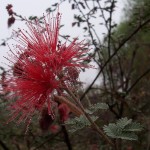 Baja Fairy Duster Calliandra californica: This native to Baja California and Sonora, Mexico, is an evergreen shrub with an open growth that can reach 5 ft to 5-6 f wide. This species is sometimes compared to Fairy Duster Calliandra eriopylla, which is smaller (to 3 ft x 3-4 ft wide), summer deciduous to evergreen, with less luxuriant foliage. There is also a hybrid available called ‘Maricopa Red’. These sturdy yet fine-textured shrubs like hot dry situations, although the Fairy Duster C. eriophylla can also tolerate the warmer coastal environments. They all like the full sun and need good drainage. With little to moderate water the Baja Fairy Duster C. californica and its cousin ‘Maricopa Red’ bloom year round; Fairy Duster C. eriophylla starts in late winter and goes into early summer, but leaves and bloom last longer if some summer water is given (the Fairy Duster is summer-deciduous). All produce the characteristic exotic duster-like flowers that are puff balls of deep red or light to deep pink stamens (C. Eriophylla) ½ to ¾ inch in size that are irresistible to hummingbirds.
Baja Fairy Dusters C. californica produce flattened seed pods 2-3 inches long and dark brown; those of Fairy Duster C. eriophylla are quite attractive: to about 2 inches long, brown with red margins and a fuzzy coating that catches the sunlight. This one can be used for erosion control as it spreads by rhizomes.
These shrubs work well in the low water landscape as accent or massed as groundcovers (especially the smaller C. eriophylla). Try setting off their fine textured foliage next to more sturdy succulents or cacti to lend them a softening effect; The Fairy Duster C. eriophylla also makes a great specimen in a glazed container.
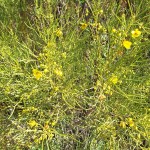 Feathery Cassia (also called “Old Man Senna”) Senna artemisioides (sometimes sold as Cassia artemisoides). This Native to Australia has silvery-grey, needle-like foliage and is 3 to 5 ft tall and wide with an airy open structure. It can take full sun or partial shade and likes well draining soil. Beginning in late fall, it covers itself with a profusion of yellow ¾ inch clusters of 5 to 8 flowers puff balls of flowers that can continue into early summer when the shrub takes a rest, to start again in late fall. Its reddish-brown flattened, 1½ inch long narrow seedpods hang on for a long period of time, but in the heat of summer this provides an attractive contrast to the silvery foliage. It is very drought tolerant but looks best with moderate to regular water.
Grevillea ‘Poorinda Constance’
 Grevilleas are evergreen shrubs and trees most of which come to us from Australia. Of the many that we can grow in our County this one displays an open, graceful growth and can reach 8 ft tall by 12 ft wide. Its needle-like, deep green 1 inch long leaves are almost white beneath. The shrub produces clusters of orange-red flowers in winter and spring and intermittently at other times. It needs full sun or partial shade and little or no water. As a spectacular screening or specimen shrub it will mask unsightly views or provide privacy.
WINTER-BLOOMING SUCCULENTS
Aloe Aloe arborescens
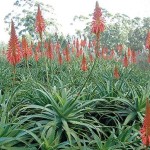 The Aloes are primarily South African natives that range in size from 6 inch to tree-like, but all form rosettes of fleshy, pointed leaves. To me, this is the most striking and imposing Aloe as it forms a large, rounded shrub-colony that over the years can reach 10 ft high and wide. Branching stems carry big clumps of grey-green, spiny-edged leaves. Is is easy to grow in well-drained soil, can take full sun or shade and salt spray, needs little water but can take more. This makes them nice companions to perennials that have similar water- and drainage needs. Its foliage can be damaged at 27 F but will in most cases rebound. In winter, this plant produces spiky torch-like clusters of bright brick-red flowers. A variegated form is also available.
Cotyledon Cotyledon orbiculata
 This south African native can quickly reach 2 ft tall, about 2 ft wide. Its fleshy paddle leaves may be green edged with red or whitish-gray, depending on variety; its sports drooping orange-red bell-shaped flowers from late fall into spring. This succulent is suitable for the drought resistant landscaping and needs excellent drainage. Tolerant of light frosts, it is easy to propagate from cuttings and makes a great container plant.
WINTER-BLOOMING, DROUGHT TOLERANT TREES
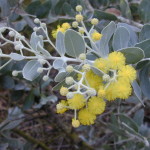 Pearl Acacia (also called Queensland Silver Wattle) Acacia podalyriifolia. Native to Australia, Mexico or the southwestern US, many attractive, winter-blooming and fragrant Acacias are available to us. The evergreen Pearl Acacia grows to 10-20 ft tall and 12-15’ wide with roundish, 1 1/2 inch long silvery gray satiny leaves. It is a shrubby plant that can be trained into a small tree. Brilliant bright yellow puffy and sweetly fragrant flowers are produced in late winter/early spring. It is tolerant of our soils and needs full sun little or no water. The Sunset Western Garden Book recommends to prune the Acacias that are grown as tree form to open up their interiors which will reduce dieback of shaded branches.
Sky Flower Duranta erecta (D. repens, D. plumieri)
This is a fast growing evergreen shrub that can be easily be trained into a small tree. It grows 10-25 ft tall and 6-10 ft wide. Especially as a multi-trunked plant it can make a beautiful specimen for the low water landscape. Its glossy green leaves are about 2 inch long on broadly arching branches that may or may not have spines. Pretty ½ inch sized violet-blue flowers in fragrant clusters are produced nearly all year and attract people, butterflies and hummingbirds. They are followed by pretty yellow berries (toxic if ingested). It grows easily in most soils in full sun or partial shade, needs only average watering and tolerates temperatures down to around 20 F.
There are also light-blue and dark-blue flowered selections of this shrub available, as well as a white one called ‘Alba’. ‘Sweet Memory’ is thornless, with flower petals edged in white. ‘Gold Mound’ is a small one, only 1 ½ ft wide and high, has brilliant gold leaves and flowers rarely, but it is excellent for adding color to container plantings.
SUPPLIERS & RESOURCES
Waterwise Botanicals a few miles north of Escondido grow exceptional xeriscape plants, including perennials, shrubs, succulents, cacti and roses. Their availability list with photos and plant descriptions is online.
Briggs Tree Company in Vista carries a wide variety of traditional landscape as well as drought resistant plants, and their list (most plants now with descriptions) is available online.
Green Meadow Growers in Bonsall also offer a great line of grasses and succulents as well as shrubs and perennials; they also make available plants from Mountain States Wholesale Nurseries who specialize in desert plant species.
Oasis Water Efficient Gardens in Escondido offer an exciting range of succulents, cacti and other low water landscape plants.
Great photos, ideas and tips for designing with succulents are presented by renowned author and photo journalist Debra Lee Baldwin, Her book ‘Designing with Succulents’ has been a wonderful resource in my design work, and I look forward to her next book, ‘Succulent Container Gardens’ that will appear shortly.